Listening meets speaking
Hearing and producing speech at the same time links what you perceive with what you say. The gap between "I understand it" and "I can say it" gets smaller.
Shadowing is a speaking technique where you listen to a native speaker and repeat what they say out loud, almost at the same moment, copying their sounds, rhythm and intonation as closely as you can. You become their "shadow".
Shadowing started as a training exercise for simultaneous interpreters, who need to listen and speak at the same time. Researchers and teachers, especially in Japan, later studied it as a way to improve listening and pronunciation in a second language.
It reached a wider audience through polyglot Professor Alexander Arguelles, who described shadowing while walking briskly outdoors and speaking loudly and clearly. Today it's used around the world, from beginners to advanced speakers preparing for exams, interviews and presentations.
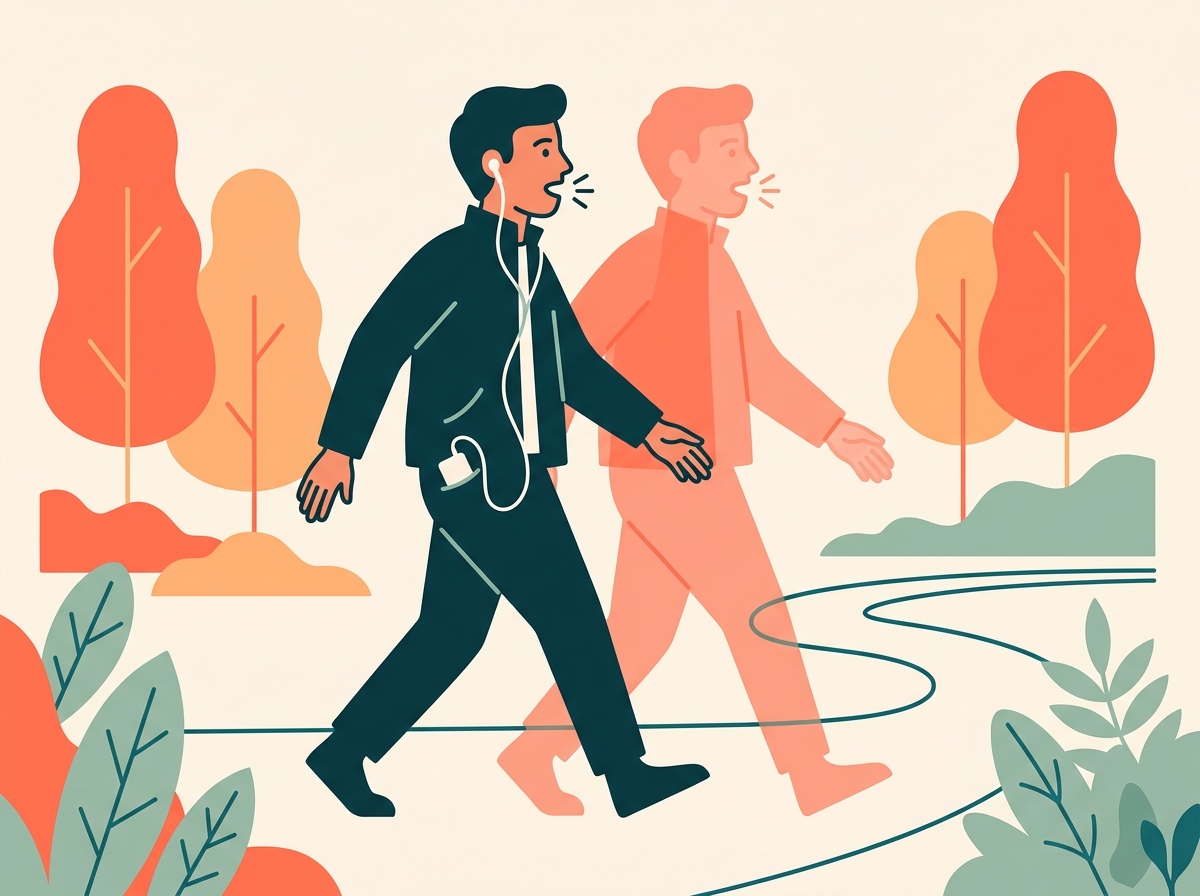
Hearing and producing speech at the same time links what you perceive with what you say. The gap between "I understand it" and "I can say it" gets smaller.
Pronunciation is partly physical. Repeating the same sounds again and again trains your tongue, lips and breathing to move the way English needs.
Native speakers use ready-made phrases. When you shadow, whole expressions go into memory together, which makes speaking faster and more natural.
Compared with traditional "listen and repeat", shadowing has a few defining features.
| Feature | Shadowing | Traditional repeat-after-me |
|---|---|---|
| Timing | Speak along in real time, 0.5–1 second behind | Wait until the sentence ends, then repeat |
| Focus | Sound, rhythm, stress and melody | Mostly individual words |
| Material | Authentic speech: dialogues, podcasts, talks | Often slow, isolated textbook sentences |
| Brain load | Active: listen, process and speak at once | Passive: remember, then imitate |
| Practice partner | Not needed, just audio and your voice | Usually needs a teacher |
Linking ("pick it up" → "pi-ki-tup"), reductions ("going to" → "gonna") and weak forms start to come out without effort.
Once you can produce connected speech, it becomes much easier to recognise it in films, podcasts and meetings.
Shadowed phrases are stored as ready-to-use chunks, so there are fewer "uhm…" moments while you build sentences.
Daily out-loud practice makes your English voice feel familiar, and that confidence carries into real conversations.
Good to know: shadowing works best alongside other learning, such as vocabulary, grammar and real conversations. Think of it as the gym session for your speaking muscles.